
151 Humanoid Robots Dance in Sync in Shenzhen, Setting a Guinness World Record
A group of 151 humanoid robots performed a synchronized dance in Shenzhen ahead of the APEC summit, setting a Guinness World Record and drawing crowds as China showcased its fast-growing robotics industry.
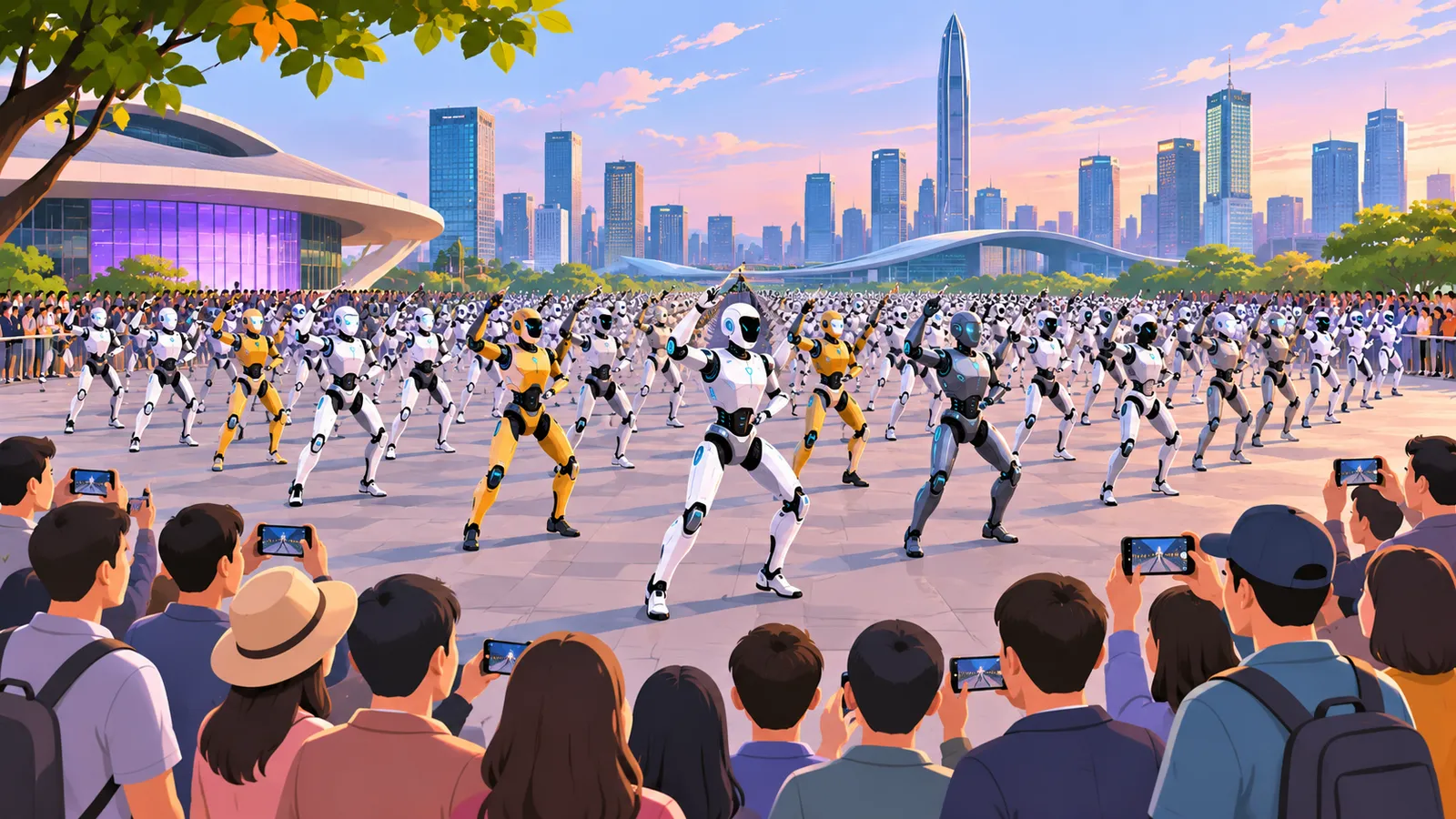
A synchronized dance performance by 151 humanoid robots in Shenzhen has become one of the most widely shared technology spectacles ahead of the Asia-Pacific Economic Cooperation (APEC) summit. The performance, held on November 17, set a Guinness World Record for the most humanoid robots dancing simultaneously within one hour, according to reports from the event.
The display took place in the southern Chinese technology hub as the city prepared to host APEC economic leaders on November 18 and 19. Crowds gathered in a central public square to watch the machines move through a coordinated routine, while visitors recorded the performance on their phones. The event turned a technical demonstration into a public-facing viral moment.
151 robots complete the synchronized routine
Reports said the performance involved 151 humanoid robots, exceeding an initial target of 110. A Guinness World Records adjudicator confirmed that the machines completed the synchronized dance within the required one-hour period. The group included 20 full-sized EngineAI T800 humanoids, alongside robots from other Chinese manufacturers.
The robots performed coordinated movements that required their control systems to keep timing and body motion aligned across a large group. Maintaining synchronization among many machines is a different challenge from programming a single robot to perform a routine, particularly when different models and manufacturers are involved.
From dance routines to public demonstrations
The dance was part of a wider series of robotics demonstrations staged around Shenzhen during the APEC gathering. Reuters reporting described humanoid robots performing martial arts routines, serving ice cream and interacting with visitors. At a media venue, robots also poured coffee for journalists, while other machines were presented in public spaces as examples of service-oriented automation.
The demonstrations gave residents and visiting delegates a chance to see robots outside conventional factory settings. Entertainment routines are visually engaging and relatively easy for spectators to understand, while service demonstrations offer a glimpse of how machines might eventually assist with repetitive tasks in public-facing environments.
Why Shenzhen used the APEC spotlight
Shenzhen is one of China's major technology and manufacturing centres, with a dense ecosystem of hardware companies, component suppliers and robotics developers. Hosting an international summit provided an opportunity to showcase that industrial base to visiting officials, business representatives and journalists.
The robot performance also fitted into a broader programme of demonstrations across the city. Reuters Connect footage described a robotics carnival featuring more than 500 robots and over 120 models from more than 100 companies, with displays covering service work, intelligent manufacturing, emergency protection and human-machine collaboration. Those activities positioned robotics as both a technology showcase and a potential export industry.
A viral spectacle is not the same as workplace readiness
Choreographed movement can demonstrate balance, motion control and the ability to coordinate multiple machines, but it does not by itself prove that humanoid robots are ready to take on complex jobs. Industrial and service tasks require reliable operation over long periods, safe interaction with people, the ability to handle unexpected objects and the flexibility to respond to changing environments.
Robotics researchers and manufacturers continue to work on dexterity, perception, battery life and autonomous decision-making. A robot that can perform a rehearsed dance may still struggle with unstructured tasks such as cleaning, sorting mixed objects or handling fragile items. The Shenzhen display should therefore be understood as a public demonstration of coordinated movement rather than evidence that general-purpose humanoid workers are already widely deployable.
What the record says about the robotics race
The event highlights the speed at which Chinese robotics companies are developing and presenting humanoid machines. Large-scale demonstrations can help manufacturers attract attention, recruit talent and introduce their products to potential customers. They also give local authorities a visible way to communicate investment in advanced manufacturing and artificial intelligence.
The commercial test will come after the cameras leave. Companies will need to show that their robots can perform useful tasks consistently, safely and at a cost that makes sense for customers. For now, the 151-robot performance has delivered a striking viral moment and a record-setting spectacle, while offering a reminder that the path from choreographed demonstration to dependable everyday work remains a substantial engineering challenge.
Sources
Related stories

GTA VI Launch Sends India’s Leave Bookings Up 45%, Remote Data Shows
India ranked fourth worldwide for the year-on-year rise in leave bookings around GTA VI’s November 19 launch, with requests reaching 1.45 times the level seen on the same Thursday in 2025. Remote reported a 32% global increase across its workforce platform.

Outlook outage turns office frustration into a wave of Friday memes
A Microsoft 365 disruption on November 12 and 13 prompted social media users to joke about an unexpected break from email and meetings, giving the outage a distinctly internet-driven afterlife.
Cannabis residue shows use 2,800 years ago in Siberia
Seeds and preserved hair from a Scythian burial mound point to cannabis use about 1,000 years earlier than previous direct evidence, a study in Science reports.

Meta adds Spaces so users can build projects with Muse
Meta's new Spaces feature lets Muse agent users create trackers, planners and project boards by describing them in chat, TechCrunch reports.