NALCO and RUSAL Explore Turning Aluminium Refinery Waste Into Strategic Scandium
India's NALCO and Russia's RUSAL have signed an MoU to exchange expertise and assess ways to recover scandium from red mud, a residue of alumina production. The agreement is exploratory; no investment, plant location, commercial output or implementation timetable has been announced.
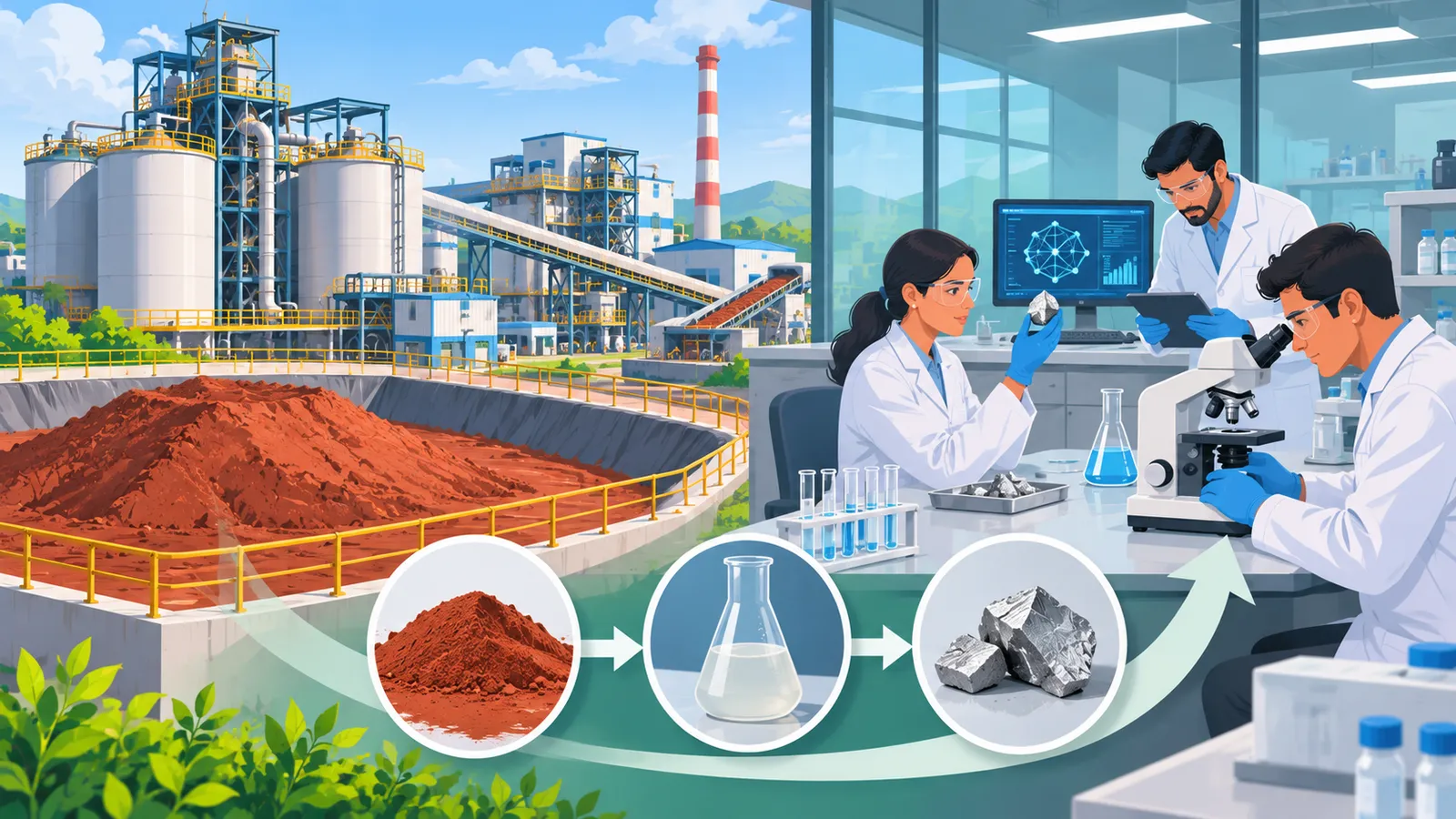
National Aluminium Company Limited (NALCO) and Russian aluminium producer RUSAL have agreed to explore the recovery of scandium from red mud, an industrial residue generated during alumina production. The two companies signed a memorandum of understanding on the sidelines of the 44th International Conference and Exhibition of the International Committee for Study of Bauxite, Alumina and Aluminium (ICSOBA) in Bengaluru on November 17.
NALCO, a Navratna central public sector enterprise under the Ministry of Mines, said the collaboration will support knowledge exchange and an evaluation of viable methods for extracting the critical mineral from the residue. The announcement was made by the company on November 18 and also disclosed through a regulatory filing.
Why scandium recovery is attracting attention
Scandium is a relatively scarce metal used in specialised applications, including high-performance aluminium alloys, aerospace components and some energy technologies. Adding small quantities of scandium to aluminium can improve strength and other material properties, making it of interest to manufacturers seeking lighter or more durable components.
Its limited supply and specialised production routes have made reliable sourcing an issue for industries that use it. Recovering scandium from an existing industrial by-product could offer another potential source, while improving the value extracted from material that would otherwise require storage or management as refinery residue.
Red mud is a by-product of alumina refining
Red mud, also known as bauxite residue, is produced when alumina is extracted from bauxite ore. It contains iron oxides and other mineral components left after the refining process. Large volumes can accumulate at alumina facilities, so managing the residue safely is an ongoing operational and environmental consideration for the aluminium industry.
The material's composition can vary depending on the bauxite source and refining process. That variation matters for mineral recovery: a process that works with one residue stream may need adjustment before it can be applied economically and consistently at another site.
RUSAL brings extraction technology for evaluation
NALCO said RUSAL has developed technology for extracting scandium from red mud. Under the MoU, the companies will exchange technical knowledge and assess possible pathways for applying recovery methods. The public announcement does not specify a selected process, expected recovery rate, investment amount, plant location or target date for commercial production.
The agreement should therefore be viewed as a technical collaboration and feasibility assessment, not as confirmation that a commercial scandium plant will be built. Further engineering studies, testing of NALCO's residue streams, economic evaluation and any required approvals would be needed before a project could move to implementation.
Part of a wider effort to recover value from industrial residues
The collaboration fits a broader interest in extracting useful materials from mining and industrial by-products. NALCO has also been pursuing work on the recovery of other valuable elements from red mud and related residues, including a gallium-recovery pilot initiative at Damanjodi with research partners, as reported by industry publications.
Such projects could support India's efforts to diversify supplies of minerals needed by advanced manufacturing and clean-energy industries. Their commercial value will depend on the concentration of recoverable materials, processing costs, environmental controls, product quality and the availability of buyers.
What happens next
The immediate task for NALCO and RUSAL is to assess whether the technology can be adapted to the characteristics and scale of NALCO's red mud. The companies have not announced financial terms or a timetable for completing the evaluation. Any future decision on a demonstration unit or commercial facility would require additional details from the partners.
The MoU marks an early step towards treating alumina residue as a possible source of strategic materials rather than only a waste-management challenge. Whether scandium recovery becomes technically and commercially viable in India will depend on the results of the evaluation and the economics of producing a consistent, marketable material.
Sources
Related stories

Elastic Posts 17% Quarterly Revenue Growth as AI Tools Expand
Elastic reported $496 million in second-quarter fiscal 2027 revenue, while subscription growth, remaining performance obligations and new AI-focused products featured in its latest results.

Alibaba’s AI Cloud Growth Puts Infrastructure Spending Under the Spotlight
Alibaba reported faster growth in AI cloud and computing services, but rising investment and export-control uncertainty leave questions about how quickly demand can translate into durable returns.

24 VCs Announce ₹1,050 Crore for Karnataka Deeptech Startups
Twenty-four venture capital firms announced investment commitments of about ₹1,050 crore for Karnataka deeptech startups at the Future Makers Conclave during Bengaluru Tech Summit 2026. The proposed investments span artificial intelligence, robotics, aerospace, semiconductors, biotechnology and other advanced technologies, but deployment timelines were not specified.

Voltas and Atomberg sign agreement for an Indian air-conditioner compressor venture
Voltas and Atomberg Innovation have signed a joint venture agreement for room air-conditioner compressors, with equal planned ownership and a combined funding ceiling of ₹200 crore.