
Toyota Innova E100 Launch Set for November 26, Says Nitin Gadkari
Union Minister Nitin Gadkari has said a Toyota Innova capable of running on 100% bioethanol is scheduled to be launched on November 26. The vehicle is expected to combine a flex-fuel engine with hybrid assistance, but Toyota has yet to publish final production specifications, pricing or retail details.
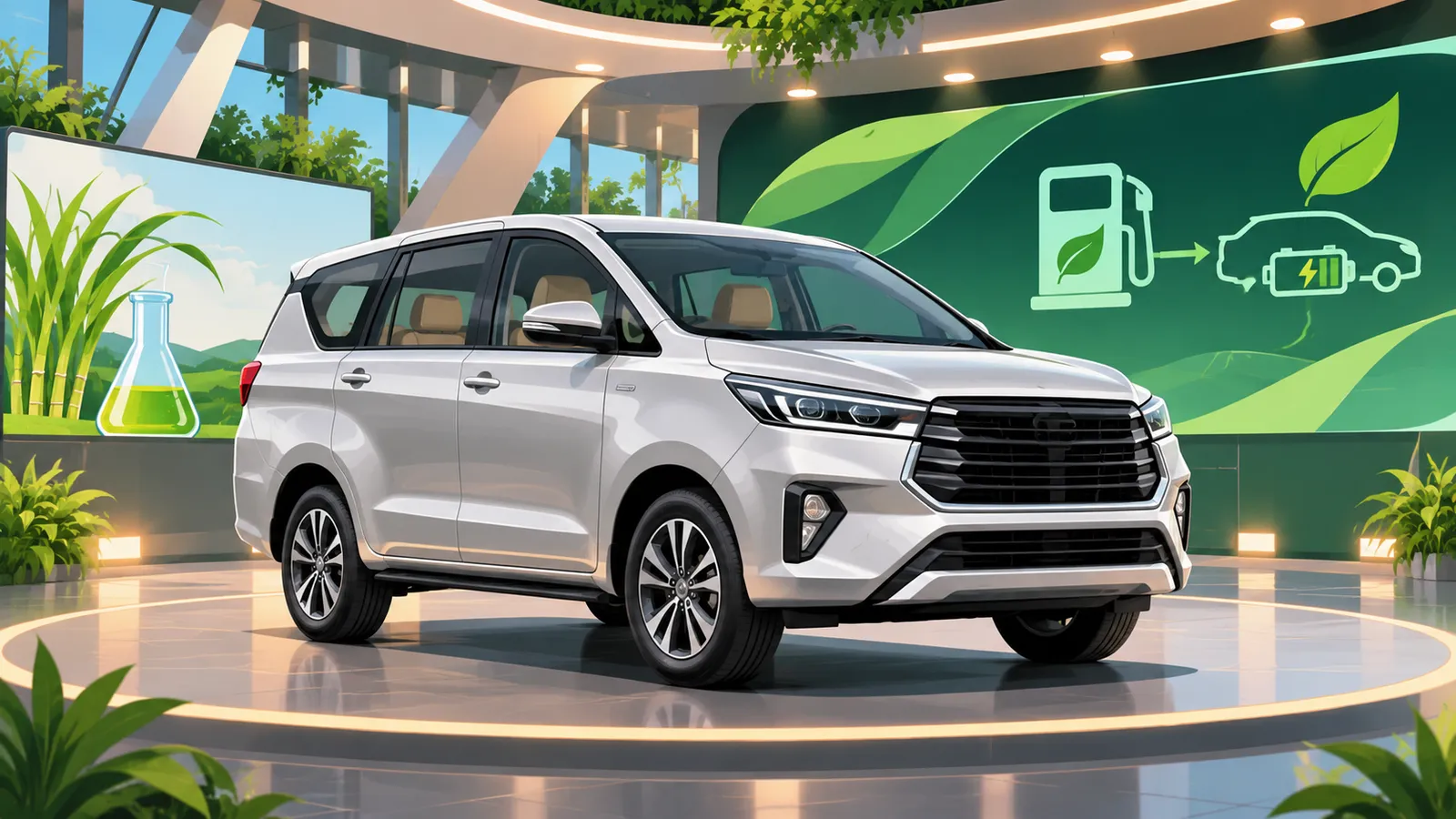
A Toyota Innova capable of running on 100% bioethanol is expected to be launched in India on November 26, according to Union Road Transport and Highways Minister Nitin Gadkari. The announcement has brought renewed attention to flex-fuel technology, which allows an engine to operate on high-ethanol blends as well as conventional petrol, and to the role of hybrid systems in alternative-fuel vehicles.
Gadkari shared the date while speaking at the Powering the Next Mile conclave in New Delhi in early November. He said the vehicle would run entirely on bioethanol and described a potential reduction in effective running costs. However, the launch date and performance claims have so far been reported from the minister’s remarks; Toyota has not yet published a complete production specification, price or retail availability plan for the vehicle.
What is expected from the E100 Innova
The vehicle is expected to build on Toyota’s Innova HyCross-based electrified flex-fuel prototype, which the company unveiled in India in August 2023. That prototype paired a flex-fuel engine with a strong-hybrid electric powertrain and was designed to operate on ethanol blends beyond E20, including higher concentrations of ethanol.
Toyota’s 2023 announcement described the prototype as a development project requiring further calibration, testing and certification. The company said the vehicle used a modified engine and hybrid system to demonstrate how high-ethanol fuels could be used in a passenger vehicle. Those earlier prototype details provide context, but they should not automatically be treated as the final specifications of the vehicle expected to be presented this month.
What E100 and flex-fuel mean
E100 refers to fuel that is essentially pure ethanol, while E85 contains up to 85% ethanol blended with petrol. A flex-fuel vehicle is designed with compatible fuel-system materials and engine-management technology so that it can operate across a specified range of ethanol-petrol blends. India’s recent regulatory update has formalised standards for vehicles designed to use blends from E20 through E85/E100.
Unlike a conventional petrol car, an E100-capable vehicle needs components and calibration designed to handle ethanol’s different chemical and combustion properties. Drivers must use only fuels approved for the vehicle and follow the fuel compatibility information in the owner’s manual. The availability of compatible fuel at retail outlets will also influence how practical such a vehicle is for everyday use.
Hybrid assistance and the running-cost claim
Gadkari has said the Innova would generate a substantial share of its operating power through electricity and that its effective running cost could be comparable to petrol priced at around ₹25–30 per litre. The claim is based on the minister’s explanation of ethanol prices and the contribution of the hybrid system. It is not an independently verified estimate of the cost every owner will experience.
Actual operating costs would depend on the price and availability of ethanol, the vehicle’s fuel consumption, driving conditions, maintenance, the share of driving supported by electric assistance and the distance travelled. Ethanol also has a different energy content from petrol, so a comparison based only on the price per litre can be misleading without considering fuel economy and total energy use.
Why India is looking at higher ethanol blends
India’s ethanol programme is intended to diversify transport fuels, create demand for domestically produced biofuel and reduce dependence on imported crude oil. Ethanol can be produced from agricultural feedstocks and other biomass sources, linking fuel policy with farming, processing and rural industry. The government has also been developing standards and distribution plans for higher ethanol blends.
The Automotive Research Association of India’s explanatory note on the October 2026 regulatory amendment says flex-fuel vehicles are designed to operate on blends from E20 to E85/E100. It notes that higher ethanol use can reduce dependence on imported crude, while the overall environmental benefit depends on the feedstock and production pathway. The note also stresses that vehicle compatibility and manufacturer guidance are important for safe use.
What buyers still need to know
Several details remain unconfirmed ahead of the expected November 26 event. Toyota has not yet published the final production model’s price, variant structure, fuel-consumption figures, warranty conditions or showroom delivery schedule in the sources reviewed for this report. It is also not yet clear how widely E100 fuel will be available to customers at launch or what arrangements will support refuelling outside major urban centres.
Potential buyers should therefore wait for the manufacturer’s official specifications and ownership information before making a purchase decision. The announcement of a launch date does not by itself confirm that vehicles will be immediately available for retail delivery or that all fuel stations will stock compatible ethanol.
A milestone for alternative-fuel passenger cars
If the vehicle is launched as described, it would be a significant public demonstration of a high-ethanol passenger-car powertrain combined with hybrid assistance in the Indian market. Its longer-term relevance will depend on real-world efficiency, fuel availability, price competitiveness, durability and the pace at which supporting infrastructure develops.
For now, the confirmed news is the launch timing announced by the minister and Toyota’s earlier work on an Innova-based electrified flex-fuel prototype. The final production details and the practical economics of ownership will become clearer only when Toyota releases the vehicle’s specifications and operating guidance.
Sources
- NDTV Auto: Nitin Gadkari Announces New Toyota Innova Flex Fuel Launch On Nov 26
- The Economic Times: New Toyota Innova to be launched on November 26, says Nitin Gadkari
- Toyota: Innova HyCross-based electrified flex-fuel vehicle prototype unveiled
- ARAI: Explanatory note on E85/E100 flex-fuel vehicle regulation
Related stories
Hyundai Opens NEIRA Pre-Bookings for Its New Seven-Seat Electric SUV
Hyundai Motors Indonesia is preparing to take pre-bookings for the locally produced NEIRA electric SUV at GAIKINDO Auto Week, which runs from November 20 to 29.
BYD’s Denza Enters India With Two Luxury Electric Vehicles
BYD Group’s luxury brand Denza has entered India with the D9 electric MPV priced at ₹90 lakh and the Z9 GT performance EV at ₹1.57 crore. The launch adds a premium electric brand to a market where luxury carmakers are competing for a small but higher-value segment.

Tata Sierra.ev Earns Five Stars in Bharat NCAP, Scoring 30.62 for Adult Safety
The Tata Sierra.ev has received a five-star Bharat NCAP rating for adult and child occupant protection. The electric SUV scored 30.62 out of 32 for adults and 45 out of 49 for children, with the assessment applying to the listed range.
Mercedes-Benz adds a locally assembled electric SUV to India's luxury market
Mercedes-Benz has launched the GLC Electric in India at ₹78.5 lakh, with a 94 kWh battery, dual-motor all-wheel drive and a claimed WLTP range of up to 711 km.