
Tiny crystals point to an ancient mountain system hidden beneath Antarctic ice
Researchers analysed 1,712 zircon grains from Antarctic sediments and found evidence of Himalayan-scale mountain building during Gondwana's formation, with possible links to ancient ocean chemistry.
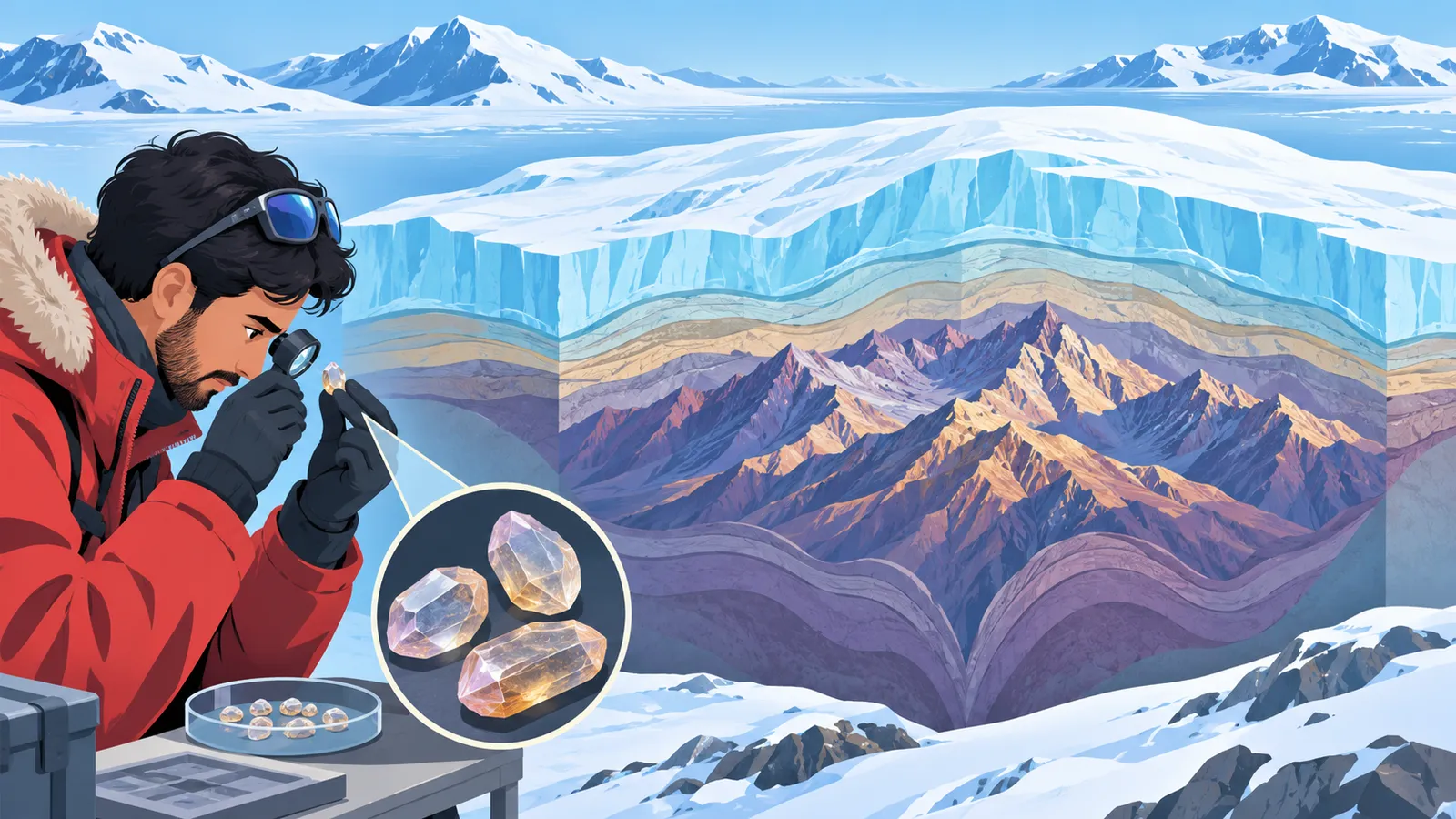
Mineral grains recovered from sediments around Antarctica are helping scientists reconstruct an enormous mountain system that formed during the assembly of the ancient supercontinent Gondwana. Researchers from the Australian National University and the GFZ German Research Centre for Geosciences analysed 1,712 zircon grains and identified evidence of major mountain-building events between about 650 million and 450 million years ago.
The team describes the ancient ranges as the Gondwana Supermountains. Their roots are thought to lie beneath the Antarctic ice sheet today, even though the original peaks have long since been eroded. The findings provide a new way to understand the continent's geological history and raise questions about how mountain erosion may have affected ocean chemistry before the rapid diversification of animal life.
Why scientists looked at tiny crystals
More than 99.5 per cent of Antarctica is covered by thick ice, making direct investigation of much of its underlying rock difficult. Instead of trying to sample the buried mountains themselves, researchers examined sediment collected from the continental margin through ocean-drilling work.
The samples contained detrital zircons, durable mineral grains that can preserve information about when their parent rocks formed and the conditions under which they crystallised. Uranium-lead dating helps determine the age of a zircon, while its chemical composition can provide clues about the pressure and geological environment in which it developed.
The researchers compared the Antarctic grains with wider global datasets. The age pattern showed a strong concentration between 650 million and 450 million years ago, a period associated with the assembly of Gondwana. The chemical signatures were consistent with formation deep within the roots of very large mountain belts, comparable in scale to the modern Himalayas.
How Gondwana was assembled
Gondwana brought together landmasses that now form parts of Antarctica, India, Africa, South America, Australia, Arabia and Madagascar. The process involved the collision and joining of continental blocks over a long period. Those collisions compressed and thickened the crust, producing mountain belts that were later worn down by weathering and erosion.
The new analysis points to major Antarctic mountain-building events during this assembly. The researchers say the zircon record indicates that Antarctica played a much larger role in the global history of mountain formation than some earlier compilations suggested. That difference partly reflects how difficult the continent is to sample: a region with very little accessible rock can be under-represented in global geological datasets.
The study does not mean that intact Himalayan-height peaks remain beneath the ice today. The evidence is for their eroded roots and the minerals that were carried away from them. The original mountain landscape has changed substantially over hundreds of millions of years.
A possible connection to ancient ocean chemistry
The researchers also discuss how erosion of such large mountain systems may have influenced the environment. Weathering can carry nutrients from rocks into rivers and eventually into the ocean. Those nutrients can support biological productivity, including the growth of photosynthetic organisms that form the base of marine food webs.
Large volumes of sediment can also bury organic carbon. If carbon is buried before it reacts with oxygen, it can affect the balance of oxygen in the atmosphere and oceans over geological timescales. The authors suggest that erosion and sediment burial linked to the Gondwana Supermountains may have contributed to environmental conditions associated with the rise of animal life.
This is a proposed connection, not proof that the mountain system directly caused the Cambrian explosion. The appearance and diversification of animal groups involved many interacting environmental and biological processes. The timing of geological events can support a hypothesis, but it does not establish a single cause on its own.
What the findings add
The work adds a new set of mineral evidence to the reconstruction of Antarctica's ancient geological history. It also highlights the importance of sampling regions that are difficult to study directly. Tiny crystals carried to the ocean margin can preserve clues about landscapes that no longer exist and that remain hidden beneath modern ice.
Further research will be needed to test how the mountain-building events affected nutrient supply, carbon burial and oxygen levels. Scientists will also need to compare the Antarctic record with evidence from other parts of Gondwana and with independent geological and fossil records.
The discovery is therefore best viewed as a stronger reconstruction of an ancient mountain system and a new piece of evidence in a much larger question about Earth's changing environment. The zircon grains do not reveal every detail of the vanished peaks, but they provide a rare window into a period when continental collisions reshaped Antarctica and may have helped set the stage for later changes in life on Earth.
Sources
Related stories

India and EU finish Horizon Europe talks, opening a path to direct research funding
India and the European Union have concluded negotiations on India's association with Horizon Europe, but researchers will gain access to the new funding arrangements only after the agreement is signed and procedures are completed.

India Unveils Indigenous H5N1 Vaccine for Poultry After Bhopal Trials
India has unveiled an inactivated H5N1 vaccine developed by ICAR-NIHSAD in Bhopal for chickens. The vaccine targets clade 2.3.2.1a, and institute-reported trials found protection lasting up to six months, although wider rollout arrangements have not yet been detailed.

India Prepares to Unveil Indigenous H5N1 Vaccine for Chickens
India is set to dedicate its first home-developed inactivated H5N1 vaccine for chickens on November 20. Developed by ICAR-NIHSAD in Bhopal, it targets the Clade 2.3.2.1a strain linked to many poultry outbreaks.
India Puts Integrated Reservoir Management at the Centre of Its Water-Security Debate
A national conference in Pune has brought government agencies, researchers and engineers together to discuss reservoir coordination, climate resilience, dam safety and digital water-management tools.