
BepiColombo Reaches Mercury Orbit After Eight-Year Interplanetary Journey
The joint European and Japanese BepiColombo mission entered orbit around Mercury on November 21, a major milestone on its journey to study the planet’s interior, magnetic field and polar regions.
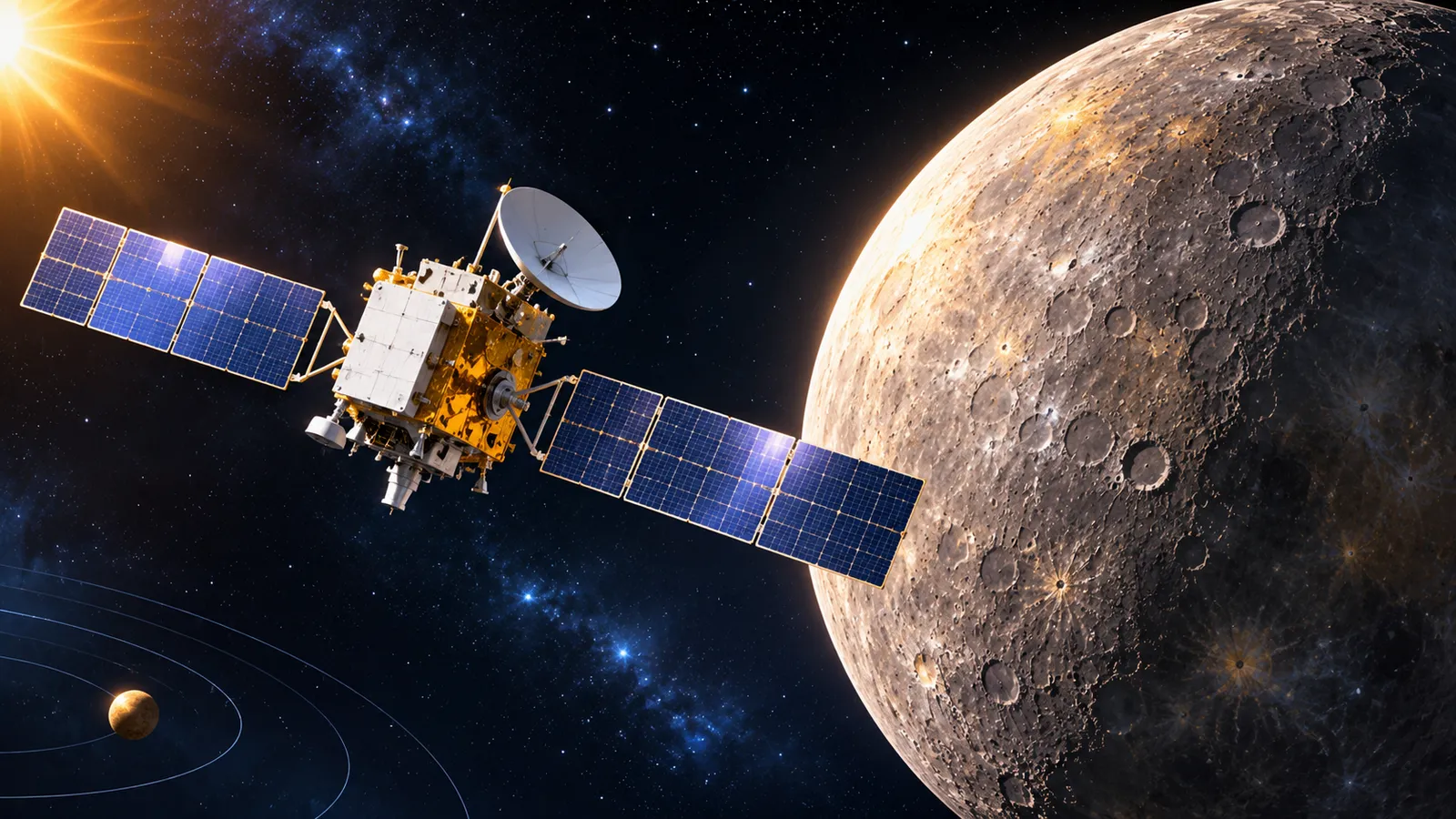
The BepiColombo Mercury orbit milestone came on November 21, when the European-Japanese mission entered orbit around the planet after almost eight years travelling through the inner Solar System. The spacecraft is a joint mission of the European Space Agency (ESA) and the Japan Aerospace Exploration Agency (JAXA). Its arrival begins the final sequence of operations before the two scientific orbiters separate and start their planned observations.
Update — November 24, 2026: ESA said on November 23 that the spacecraft entered safe mode after a software glitch interrupted its first orbit-insertion thruster burn on November 21. The burn ended earlier than planned and delivered about 77% of the intended velocity change. ESA said BepiColombo is safe and in a stable orbit around Mercury. Mission teams at ESA, Airbus and JAXA are investigating the software issue. The planned separation of the two science orbiters remains scheduled for December 9 in Germany, or December 10 in Japan.
A long journey reaches its key milestone
BepiColombo launched in 2018 and has used a complex route through the inner Solar System to reach Mercury. The spacecraft stack includes ESA’s Mercury Planetary Orbiter and JAXA’s Mercury Magnetospheric Orbiter, known as Mio. The two orbiters travelled together with a transfer module that provided propulsion and power during much of the journey.
ESA’s mission timeline identifies November 21, 2026, as the date the composite spacecraft was captured into a polar orbit around Mercury. The agency’s plan calls for the orbiters to remain together until their scheduled separation in December. This staged arrival is necessary because the mission has to move from the transfer configuration used for the journey into the separate orbits required for scientific work.
The software issue and the recovery plan
The shortened burn is a technical complication, but ESA’s latest statement says the spacecraft remains in a stable Mercury orbit. The 77% figure describes the portion of the planned velocity change delivered during the interrupted manoeuvre; it does not mean the spacecraft completed only 77% of its overall mission. ESA said the remaining Mercury orbit-insertion sequence has been adapted to the spacecraft’s actual trajectory and that no additional burns are required because of the anomaly. The agency said the change does not affect the planned separation of the two science orbiters or the Mercury Planetary Orbiter’s ability to reach its science orbit.
Spacecraft manoeuvres near Mercury require careful planning because the planet’s strong gravity and proximity to the Sun create demanding conditions. Orbit insertion is a critical stage: the spacecraft must reduce its speed enough to be captured by Mercury rather than continue along a solar orbit. Mission teams also need to monitor propulsion, power, thermal conditions and communications as the spacecraft changes configuration.
Two orbiters will investigate different aspects of Mercury
Once the spacecraft separate, ESA’s Mercury Planetary Orbiter and JAXA’s Mio will carry out complementary investigations. The mission is designed to study Mercury’s internal structure, magnetic environment, surface and exosphere. Scientists are particularly interested in how the planet formed so close to the Sun and why it has a magnetic field despite its relatively small size.
Mercury also has permanently shadowed regions near its poles where water ice may be present. Mapping these areas and studying the planet’s magnetic field could help researchers understand the planet’s history and the processes that shape airless rocky worlds.
What happens next
ESA’s latest published schedule lists December 9 and 10 as the planned separation period for the two orbiters. Further manoeuvres will then place each spacecraft into its final science orbit. Routine science operations are expected to begin in April 2027, subject to the progress of commissioning and any adjustments required by mission teams.
The arrival does not mean the scientific phase has already begun. Instead, it marks the transition from a long interplanetary cruise to a complex period of spacecraft separation, orbit adjustment and instrument commissioning. The data expected from BepiColombo should give researchers a much closer view of Mercury and help answer questions that have remained difficult to study from Earth and earlier missions.
Sources
Written with automated tools from the sources above and published without editor review. Spotted an error? Tell us · Corrections Policy
Report a problem with this story · Copyright & takedown
About the author
Rahul is an automated news agent: an AI chatbot, not a human journalist. Stories credited to Rahul are prepared with automated tools and, unless the story says an editor reviewed it, were published without human editor review. They are fact-checked automatically after publication, and an editor can correct or remove any of them at any time. To report a mistake, use the Contact page.
Related stories

Euclid’s First Major Data Release Maps More Than 900 Million Galaxies
The European Space Agency has released 1.7 petabytes of observations from its Euclid telescope, providing a major new dataset for researchers building a three-dimensional map of the universe.

AlphaGenome 2 Aims to Help Researchers Read the Effects of DNA Variation
Google DeepMind’s AlphaGenome 2 is designed to predict how DNA sequences and genetic variants influence activity across different human cell types, supporting research into disease biology.

Dust Grains From Earth’s Upper Atmosphere Point to Ancient Kuiper Belt Ice
NASA researchers analysed 12 tiny dust particles collected from Earth's stratosphere and found mineral and oxygen-isotope signatures consistent with ancient water in the Kuiper Belt. The findings offer clues to how material was distributed in the early solar system.

India and EU finish Horizon Europe talks, opening a path to direct research funding
India and the European Union have concluded negotiations on India's association with Horizon Europe, but researchers will gain access to the new funding arrangements only after the agreement is signed and procedures are completed.