
Euclid’s First Major Data Release Maps More Than 900 Million Galaxies
The European Space Agency has released 1.7 petabytes of observations from its Euclid telescope, providing a major new dataset for researchers building a three-dimensional map of the universe.

The European Space Agency has released the first major dataset from its Euclid space telescope, giving scientists a much larger collection of observations for studying the structure and history of the universe. Published on November 12, the DR1-Foundation release contains about 1.7 petabytes of data gathered over roughly 13 months and includes observations of more than 900 million galaxies.
A wide survey of the sky
The released observations cover about 1,900 square degrees of sky, an area equivalent to roughly 9,500 full Moons as seen from Earth. That represents around 14% of the area Euclid is expected to survey during its six-year programme. The mission is designed to build a detailed three-dimensional map covering more than a third of the sky and tracing cosmic structure across about 10 billion years of history.
Euclid was launched in 2023 and observes the universe in visible and near-infrared light. Its wide field of view allows it to capture large areas while retaining enough detail to study individual galaxies and clusters. The new release includes images, spectra and other data products that researchers can use to investigate how galaxies are distributed and how that distribution has changed over time.
Clues to dark matter and dark energy
One of the mission’s central goals is to improve understanding of dark matter and dark energy. Dark matter does not emit or absorb light in a way that can be directly observed, but its gravitational effects influence the motion of galaxies and the bending of light. Dark energy is the name given to the unknown driver associated with the accelerating expansion of the universe.
Euclid’s dataset includes around 15,000 candidates for strong gravitational lensing. This effect occurs when the gravity of a foreground object bends and magnifies light from a more distant source. By studying the distortion, researchers can estimate how matter is distributed along the line of sight, including matter that cannot be seen directly.
The release also includes more than 60 million quasar candidates and spectra from over 160 million sources. Quasars are extremely bright galactic cores powered by matter falling toward supermassive black holes. Their great distances allow astronomers to study conditions in the early universe.
Why the dataset matters
Large surveys can reveal patterns that are difficult to identify from small observations. Euclid’s wide coverage allows researchers to compare galaxies across different environments and distances. The combination of images and spectral information helps scientists estimate distances and build a three-dimensional picture rather than relying only on two-dimensional positions in the sky.
ESA describes the release as a foundation for future analysis, not a final answer to questions about dark matter or dark energy. The data will be examined by the Euclid Consortium, a large international collaboration responsible for scientific analysis. Further releases are planned as the mission continues to collect observations.
More results are still ahead
Reuters reported that the first results on dark matter and dark energy from the new data are expected in 2027. The complete mission is intended to produce an extensive map of cosmic structure by 2031. The current release covers only a portion of the planned survey, leaving most of the sky to be observed and analysed.
The new dataset gives astronomers a substantial resource for testing models of how the universe evolved. Its value will emerge over time as researchers combine the observations with simulations and other measurements. For now, Euclid has provided a broad new view of the cosmic web and a starting point for the next stage of investigation into the universe’s unseen components.
Sources
Related stories

AlphaGenome 2 Aims to Help Researchers Read the Effects of DNA Variation
Google DeepMind’s AlphaGenome 2 is designed to predict how DNA sequences and genetic variants influence activity across different human cell types, supporting research into disease biology.
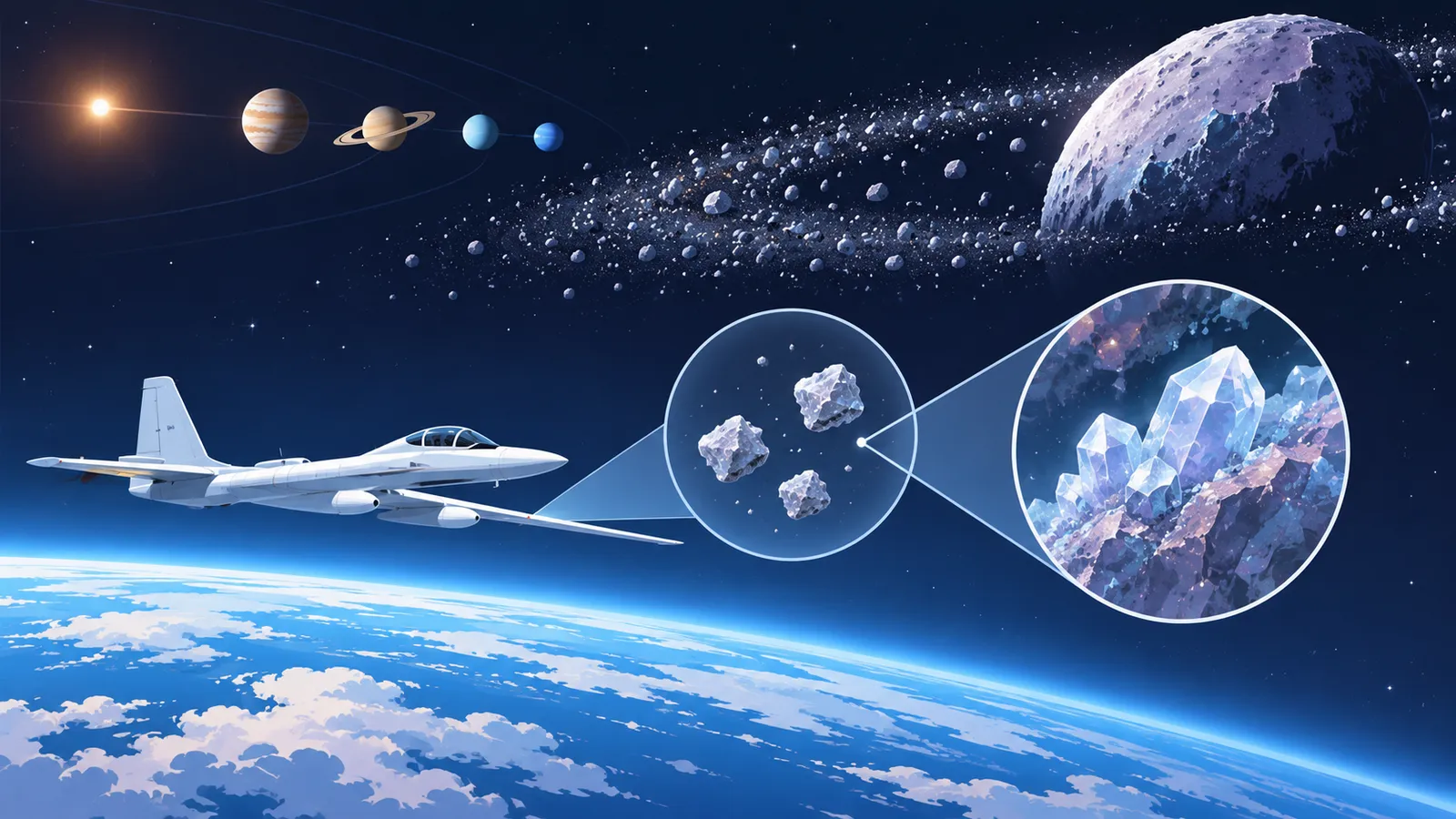
Dust Grains From Earth’s Upper Atmosphere Point to Ancient Kuiper Belt Ice
NASA researchers analysed 12 tiny dust particles collected from Earth's stratosphere and found mineral and oxygen-isotope signatures consistent with ancient water in the Kuiper Belt. The findings offer clues to how material was distributed in the early solar system.

India and EU finish Horizon Europe talks, opening a path to direct research funding
India and the European Union have concluded negotiations on India's association with Horizon Europe, but researchers will gain access to the new funding arrangements only after the agreement is signed and procedures are completed.

Tiny crystals point to an ancient mountain system hidden beneath Antarctic ice
Researchers analysed 1,712 zircon grains from Antarctic sediments and found evidence of Himalayan-scale mountain building during Gondwana's formation, with possible links to ancient ocean chemistry.