
New atlas maps 652 community seed banks as India strengthens farmer-led conservation
The DIVERSIFARM-India project has mapped 652 community seed banks and released a practical manual and policy recommendations aimed at supporting locally managed seed systems.
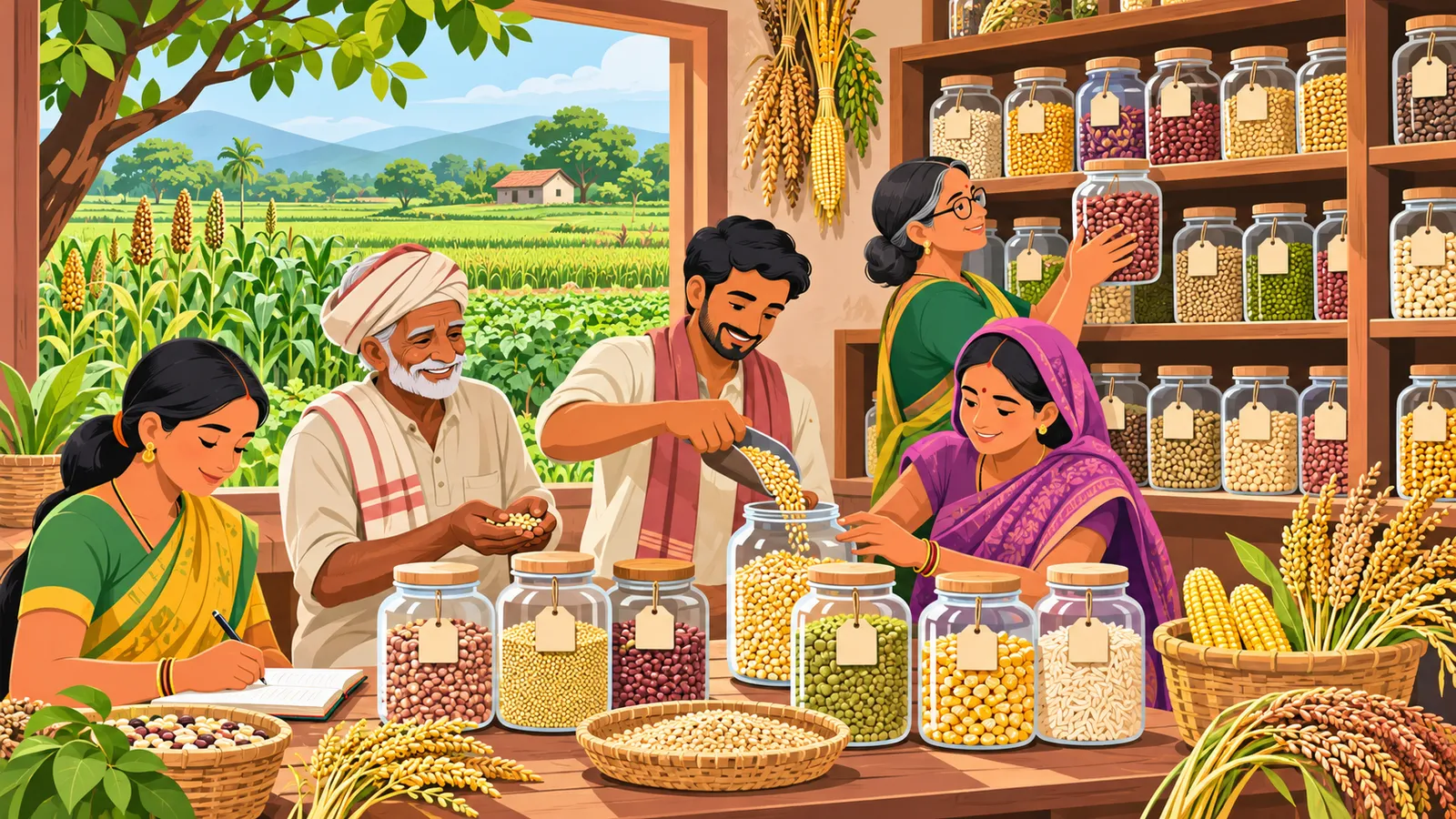
A new digital atlas has mapped 652 community seed banks across India, giving researchers and policymakers a clearer picture of farmer-led institutions that conserve and exchange locally adapted crop varieties. The mapping was presented by the DIVERSIFARM-India project at a national seminar in New Delhi on November 17 and 18, alongside a capacity-building manual, a policy brief and a roadmap for Odisha.
The project survey estimates that India has at least 1,000 community seed banks. The 652 entries in the atlas are the institutions mapped so far, not 652 newly opened facilities and not a complete census of the national network. The difference is important: the map is a growing record of existing institutions, while the larger estimate describes the scale of the system the project believes is present.
What community seed banks do
Community seed banks are locally managed arrangements through which farmers conserve, store and exchange seeds of crop varieties that are important to their area. They can help maintain diversity in farmers' fields, preserve knowledge about planting and selection, and make locally adapted seed available within a community.
Unlike a central gene bank, a community seed bank is connected to the everyday decisions of farmers. Its value depends on whether members can access seed when they need it, whether the varieties remain viable and whether local knowledge is passed between generations. The institutions may differ in how they are organised, who manages them and how they obtain resources.
DIVERSIFARM-India is a collaboration involving the M S Swaminathan Research Foundation and Norway's Fridtjof Nansen Institute. Its work focuses on strengthening existing farmer-managed seed systems and examining the policy and institutional support they need. The project has used mapping and case studies, including work in Odisha, to understand the different models operating across the country.
Four outputs shared in New Delhi
The seminar presented a geographic atlas with profiles of mapped seed banks, a typology that groups institutions according to how they are managed, a capacity-building manual and a policy roadmap for Odisha. The typology identifies six broad organisational forms, reflecting the fact that a single administrative model may not suit every community.
The manual is intended to help groups establish, operate and sustain community seed banks. Practical tasks can include maintaining records, storing seed appropriately, documenting local varieties and organising exchange between members. Such guidance is useful because the long-term value of a seed bank depends on consistent management, not simply on the existence of a storage space.
The Odisha roadmap proposes a 10-point set of actions, including a dedicated secretariat under the state's agriculture department. It is a recommendation from the project, not an announcement that the state government has already created such a body or committed new funding.
Why policy and local governance matter
Community seed banks operate within a wider legal and institutional environment. The project's work examines how the Protection of Plant Varieties and Farmers' Rights Act and the Biological Diversity Act can support farmer-led conservation. Coordination between different laws and agencies can influence how seed resources are documented, exchanged and protected.
Support may also need to include regular funding, training and access to technical advice. A bank may have a strong collection but struggle to keep records, maintain seed quality or reach younger farmers if it lacks people and resources. The project argues that policy support should reflect the different needs of each type of institution rather than treating all seed banks as identical.
Mapping is a beginning, not an outcome measure
The new atlas makes institutions easier to locate and compare, but a mapped entry does not prove that a seed bank is fully active or that every listed variety is available. A map also cannot by itself measure whether farmers are using the seed, whether collections remain viable or whether crop diversity has increased. Those questions require follow-up with the communities that manage the institutions.
The survey estimate of at least 1,000 banks suggests that more work remains to document the network. The difference between the estimate and the mapped total should not be interpreted as a verified national coverage rate because the estimated total is not an exact census denominator.
The project has therefore produced both a record of institutions and practical recommendations for supporting them. Its longer-term significance will depend on whether the atlas helps farmers, researchers and governments identify gaps, strengthen local management and maintain access to diverse seed. The next step is not simply to increase the number of points on a map, but to ensure that the institutions behind those points continue to serve farming communities.
Sources
Related stories

Society should condemn disrespect to Basavanna, says scholar
Sarvadhyaksha of the 19th Dharwad Zilla Kannada Sahitya Sammelan Veeranna Rajur calls upon the legal fraternity also to condemn such instances
DRI seizes over 70 kg of heroin worth ₹700 crore in Chennai
DRI officials raided an ice-manufacturing factory in Madhavaram; DMK president M.K. Stalin says Tamil Nadu has become a ‘vice city’ under TVK rule
Fisherfolk from Kasimedu harbour go on indefinite strike
Manivannan, of the Chennai Kasimedu Boat Owners Association, said that the seizure of boats by villagers in Andhra Pradesh had been happening for several decades
New PUC Rules Give Newer BS-VI Vehicles Longer Renewal Windows
India has revised pollution certificate validity by vehicle age and emission standard, giving newer BS-VI vehicles longer intervals while retaining more frequent checks for older models.