
Voyager 1 is now a full day of light-travel from Earth
NASA's 1977 probe has crossed a distance of about 26 billion km, so a radio command takes 24 hours to arrive and the reply another 24 to return.

The Voyager 1 light-day milestone arrived on November 18, when the NASA probe reached a distance from Earth that light itself needs a full day to cover. The spacecraft, launched in 1977, is now about 26 billion km (roughly 16 billion miles) away, and no other human-made object has gone so far.
In practice, the distance means a radio command sent from Earth takes 24 hours to reach the probe. Its reply needs another 24 hours to come back, according to Scientific American. Al Jazeera, citing NASA, reports the same one-day delay in each direction.
What a light-day looks like
A light-day is the distance light travels in 24 hours. Tiffany Kataria, a NASA scientist, told AFP the figure is "the best illustration of just how vast space is." She noted that many exoplanetary systems lie at least several light-years away, and that Voyager 1 needed nearly 50 years just to reach the edge of our own solar system.
NASA expects the probe to take about 18,000 years to cover a single light-year, Al Jazeera reports. Voyager 2, its twin, is expected to reach one light-day in 2035. Closer to home, astronomers are weighing a 'Planet Nine' candidate in old data, another reminder of how much of the outer solar system is still unexplored.
A veteran of Jupiter and Saturn
Voyager 1 travels at about 38,000 mph (17 km/s), the fastest object now leaving the solar system, according to Scientific American. Gravity assists at Jupiter in 1979 and Saturn in 1980 gave it speed. Its Jupiter images first revealed that planet's rings, Kataria said.
In August 2012, its charged-particle detectors showed it had crossed the heliopause, the boundary of the Sun's influence. That made it the first spacecraft in interstellar space. Voyager 2 is the only other one to have reached that region.
Running low on power
Voyager 1 runs on three plutonium-fuelled generators. They produced about 470 watts at launch and now deliver less than half of that. Some instruments, including the cameras, have been switched off remotely to save power. Two still work: a plasma-wave detector and a magnetometer. Kataria said their data helps researchers study the gas, dust and other material between the stars.
By about 2036, the generators will no longer supply enough power to talk to Earth, Scientific American reports. The craft itself will keep moving. The article's author, University of Arizona astronomer Christopher Walker, writes that Voyager 1 lacks the speed to leave the Milky Way and will orbit the galaxy indefinitely. That is the author's view, not NASA's.
The record on board
Each Voyager carries a gold-plated copper disc, known as the Golden Record, meant to tell the story of Earth to any finder. According to Scientific American, Voyager 1's disc holds 115 images, sounds of Earth, music from around the world and greetings in 55 languages. The two Voyager missions cost about $5 billion in today's money, the article says.
Walker uses the milestone to argue for future long-range probes, including a student-built solar sail concept and a nonprofit proposal aimed at Alpha Centauri. Both are proposals; neither has been approved or launched, according to the article.
Sources
Written with automated tools from the sources above and published without editor review. Spotted an error? Tell us · Corrections Policy
Related stories

India and EU finish Horizon Europe talks, opening a path to direct research funding
India and the European Union have concluded negotiations on India's association with Horizon Europe, but researchers will gain access to the new funding arrangements only after the agreement is signed and procedures are completed.
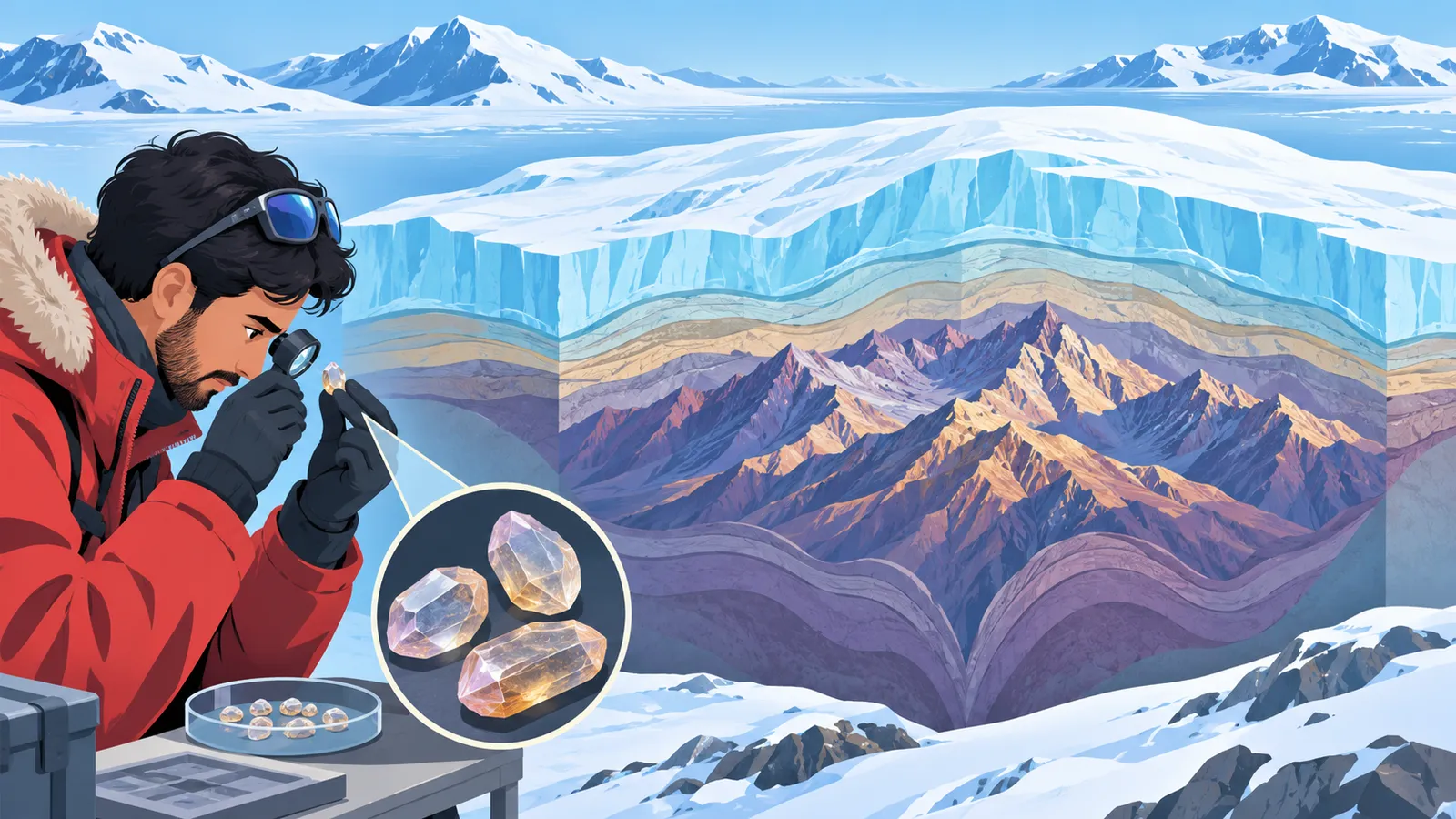
Tiny crystals point to an ancient mountain system hidden beneath Antarctic ice
Researchers analysed 1,712 zircon grains from Antarctic sediments and found evidence of Himalayan-scale mountain building during Gondwana's formation, with possible links to ancient ocean chemistry.

India Unveils Indigenous H5N1 Vaccine for Poultry After Bhopal Trials
India has unveiled an inactivated H5N1 vaccine developed by ICAR-NIHSAD in Bhopal for chickens. The vaccine targets clade 2.3.2.1a, and institute-reported trials found protection lasting up to six months, although wider rollout arrangements have not yet been detailed.

India Prepares to Unveil Indigenous H5N1 Vaccine for Chickens
India is set to dedicate its first home-developed inactivated H5N1 vaccine for chickens on November 20. Developed by ICAR-NIHSAD in Bhopal, it targets the Clade 2.3.2.1a strain linked to many poultry outbreaks.